

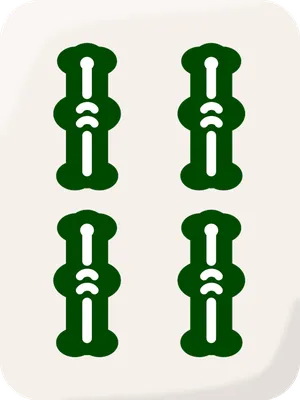
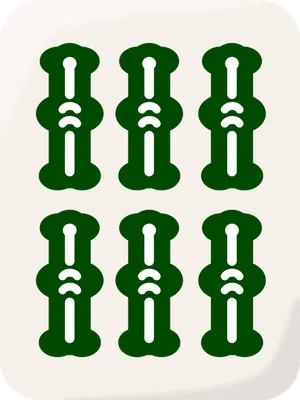
Winning a hand (agari) is the act of announcing to everyone that your hand is complete and ending the current round. When you win, you can collect points from the other players depending on the shape of your hand.
There are two main ways to win in Riichi Mahjong. One is tsumo, where you draw the tile you need on your own turn and complete your hand. The other is ron, where you take a tile discarded by another player to complete your hand.
The basic winning conditions are the same for both methods. However, how points are paid and which yaku apply depend on how you won.
To win in Riichi Mahjong, you must meet all three of the following conditions.
Tenpai means a state in which you can complete your hand with just one more tile. The tiles you need to complete the hand are called winning tiles. There can be two or more kinds of winning tiles.
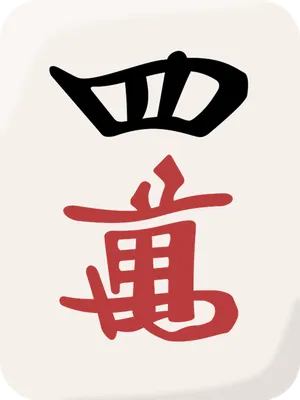
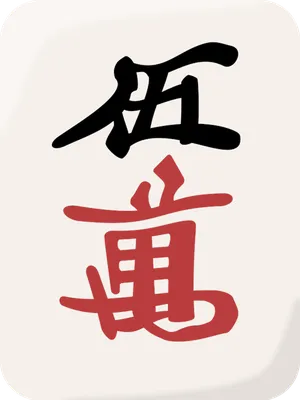
For example, if you hold 1-man and 2-man, drawing a 3-man lets you complete a sequence. If your other sets and pair are already ready, the 3-man becomes your winning tile.
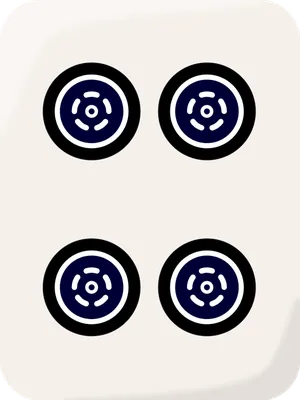
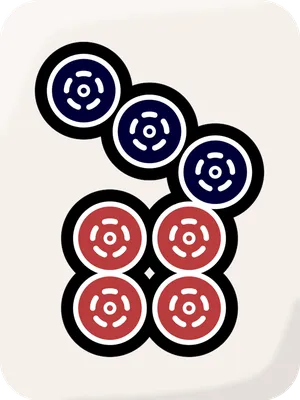
▲ A hand in tenpai
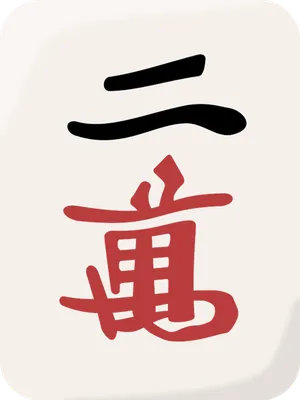
▲ The winning tiles for this hand (if you get either of the tiles above, the hand is complete)
Tsumo is a way of winning in which the tile you draw from the wall on your own turn completes your hand.
When you win by tsumo, the other three players split the payment. The amount each player pays depends on whether the dealer or a non-dealer won. For the exact amounts, see Score Calculation.
1. On your turn, draw one tile from the wall.
2. Check whether your hand is complete, including the tile you drew.
3. If it is a complete hand with a yaku, declare tsumo.
4. Reveal your hand and calculate the score.
5. The other three players pay the set amounts.
Because tsumo means drawing the tile yourself on your own turn, you do not have to wait for another player's discard.
Ron is a way of winning that you declare when another player discards a tile that completes your hand.
The tile you declare ron on must be one of your current winning tiles. Also, you cannot declare ron while in furiten.
When you win by ron, the single player who discarded the tile pays the full amount. Unlike tsumo, the other two players do not pay the base winning points. For the exact amounts, see Score Calculation.
1. Another player discards a tile.
2. Check whether that tile is one of your winning tiles.
3. If you can ron and have a yaku, declare ron.
4. Reveal your completed hand and calculate the score.
5. The player who discarded the tile pays the winning points.
| Category | Tsumo | Ron |
|---|---|---|
| How you win | Complete the hand with a tile you draw yourself | Complete the hand with another player's discard |
| When you declare | On your own turn to draw | Right after another player's discard |
| Payment | Split among the other three players | The discarder pays in full |
| Furiten | Possible even in furiten | Not possible in furiten |
| Fully Concealed Hand | Counts as a yaku if you win by tsumo with a closed hand | Not applicable |
The most important differences are who supplied the tile you won on and who pays the points.
Some yaku are valid, or are worth a different number of han, depending on how you win.
Fully Concealed Hand is a 1-han yaku that applies when you win by tsumo with a closed hand. It applies when you keep your hand uncalled and win by drawing the tile yourself.
If you win by tsumo with an open hand, Fully Concealed Hand does not apply. Winning by tsumo itself is still allowed, but you cannot get this yaku's han.
Under the Sea is a 1-han yaku for winning by tsumo on the last tile of the wall. Under the River is a 1-han yaku for winning by ron on the last discard, right after the last tile is discarded.
| Yaku | How you win | Condition |
|---|---|---|
| Under the Sea | Tsumo | Win on the last tile of the wall |
| Under the River | Ron | Win on the tile discarded by the player who drew the last tile of the wall |
Both yaku involve the last tile, but which one applies depends on whether you win by tsumo or by ron.
After a Kan is a 1-han yaku that applies when you declare a kan, draw a replacement tile, and win by tsumo.
Robbing a Kan is a 1-han yaku that applies when another player declares an added kan and the tile they are adding is your winning tile, letting you win by ron on it.
| Yaku | How you win | Condition |
|---|---|---|
| After a Kan | Tsumo | Win on the replacement tile after a kan |
| Robbing a Kan | Ron | Win on the tile another player uses to declare an added kan |
For details on the types of yaku and their han values, see the Yaku List.
Furiten is a rule that prevents you from winning by ron under certain conditions. Being in furiten does not mean tsumo is prohibited as well. Even in furiten, you can still win by tsumo if you draw one of your winning tiles on your own turn.
Types of furiten include discard furiten, which involves your own discards and your winning tiles; temporary furiten, which occurs after you miss a chance to ron; and riichi furiten, which occurs when you miss a ron after declaring riichi.
In particular, if even one of your current winning tiles appears in your own discards, you cannot ron on any of your other winning tiles either. When judging whether you can declare ron, you must check all of your winning tiles.
Two or more players can declare ron on the same discard at the same time. This is called a double ron or a triple ron.
How many of the simultaneous ron declarations are actually honored depends on the rules in use.
| Handling | Description |
|---|---|
| Double ron allowed | If two players ron at the same time, both wins are honored. |
| Triple ron allowed | If three players ron at the same time, all three wins are honored. |
| Triple ron draw | If three players ron at the same time, the round is treated as a draw. |
Whether double ron and triple ron are allowed depends on the rules of the tournament or platform. Scoring and honba handling for multiple rons also follow those rules.
First, do not check only whether the hand shape is complete. You must also check that you have at least one yaku.
Second, check for furiten before declaring ron. While in furiten, you cannot ron even if a winning tile is discarded.
Third, tsumo and ron differ in how points are paid. With tsumo, the other three players split the payment; with ron, the discarder pays in full.
Fourth, which yaku apply can depend on how you win. You need to tell apart the conditions for Fully Concealed Hand, Under the Sea, Under the River, After a Kan, Robbing a Kan, and so on.
Fifth, when several players declare ron at the same time, the outcome can differ depending on the rules in use.