



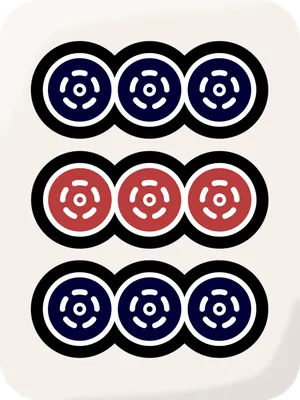


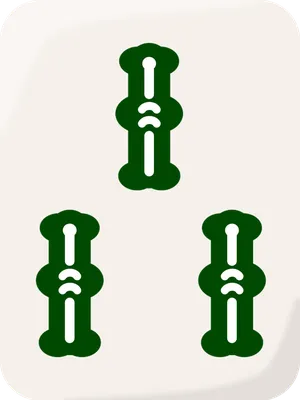
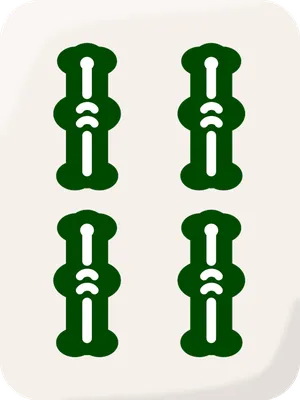
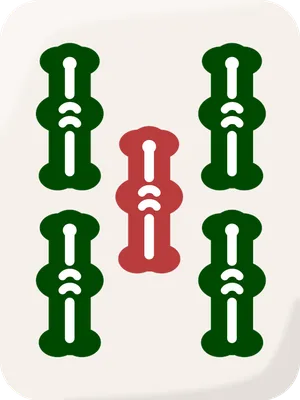

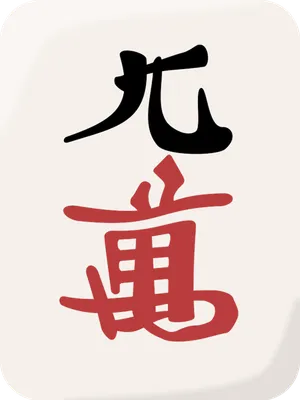





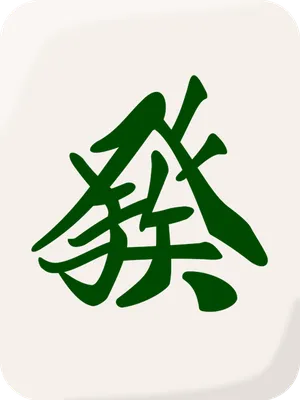
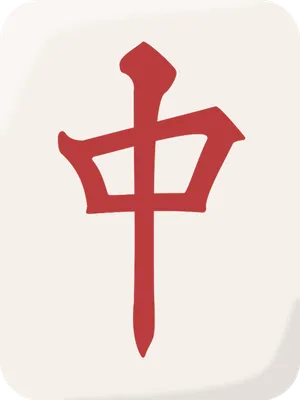
Sanma (3-player mahjong) is Riichi Mahjong played by three players. The rules for the basic winning shape, yaku, riichi, dora, furiten, and so on are similar to 4-player Riichi Mahjong, but there are differences in the tiles used, how the game is played, and how scores are calculated.
The biggest feature is that some of the manzu tiles are not used. In standard Sanma, manzu 2 through 8 are removed, and manzu 1 and 9, pinzu, souzu, and honor tiles are used.
However, the detailed rules of Sanma can differ depending on the tournament or platform. This document focuses on the widely used standard Sanma rules.
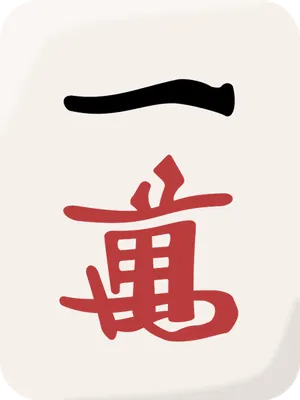
In standard Sanma, manzu 2, 3, 4, 5, 6, 7, and 8 are not used. Therefore, only the 1-man and 9-man are used among the manzu tiles.
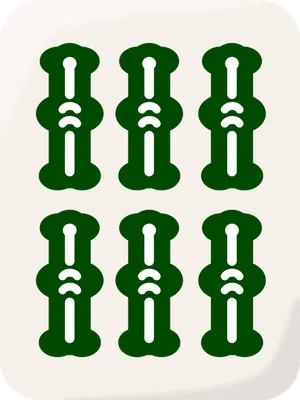
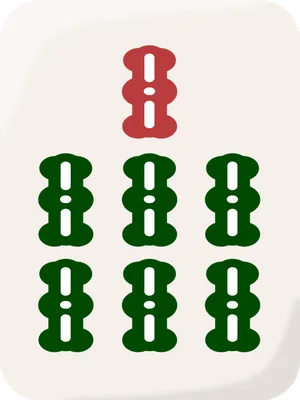
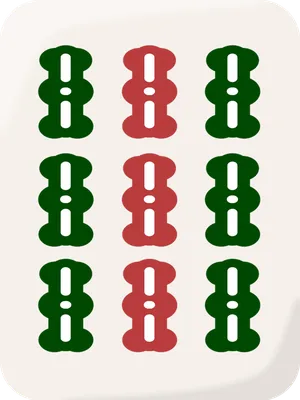
Pinzu and souzu are all used from 1 to 9, and the East, South, West, and North wind tiles and the White, Green, and Red dragon tiles are also used.
Standard Sanma uses a total of 108 tiles. This is the 136 tiles of 4-player mahjong minus the 28 tiles of manzu 2 through 8.
Unlike 4-player mahjong, where each player starts with 25,000 points, in Sanma it is common for each player to start with 35,000 points. This is because without manzu 2 through 8 it is easier to complete hands and scores come out higher.
Sanma is played by three players, so the seating arrangement and rotation differ from 4-player mahjong.
Generally only the three seats East, South, and West are used, and there is no North seat. Even if the direction you are sitting in does not correspond to East, South, or West, you take the East, South, and West seats in turn order. As the game proceeds, the dealer changes in order.
| Item | Standard Sanma |
|---|---|
| Number of players | 3 |
| Tiles used | 108 tiles |
| Seats | East, South, West |
| Dealer rotation | East → South → West |
| North seat | None |
Sanma can also be played as East-only games, East-South games, and so on. However, each wind round is played for only up to 3 rounds, so the game takes less time than 4-player mahjong.
One of the most important features of Sanma is that you cannot make a chii.
In 4-player mahjong, you can take the tile discarded by the player immediately before you to make a sequence, but standard Sanma does not allow chii.
Therefore, in Sanma the only calls for taking another player's discard are pon and kan.
| Type of call | Use in Sanma |
|---|---|
| Chii | No |
| Pon | Yes |
| Open Kan | Yes |
| Added Kan | Yes |
| Concealed Kan | Yes |
Because there is no chii, to make a sequence you must draw the tiles you need by your own tsumo. As a result, building your hand around pon and your discard strategy become important.
In standard Sanma, there is no North seat, so North tiles lose almost all their value, and a rule is used that treats North tiles as special bonus tiles. This is called Kita (also known as North dora, or pulling the North).
In rules that use Kita dora, you can reveal a North tile in your hand, remove it from your hand, and draw one replacement tile from the wall. Each revealed North tile counts as one dora when you win. This is not mandatory, and you may keep it and use it as a pair or a set. You can also simply discard it as usual.
If a North tile becomes your winning tile, many rulesets allow you to win by ron on that North tile when another player pulls a Kita.
Pulling a North tile is a special action handled differently from a regular pon or kan. After you draw a replacement tile following a Kita, you discard as usual.
If you win by tsumo on the replacement tile drawn after a Kita, it is treated as After a Kan even though you did not draw a rinshan tile.
You can Kita several times in one turn, but you cannot declare riichi immediately after a Kita.
If you draw a North tile while in riichi, you can Kita.
When you Kita, you usually call out "Pei."
Kita is not treated as a call, but it is treated as breaking the go-around, which wipes out the Ippatsu of all players who declared riichi, and after a Kita you cannot win with Double Riichi, Nine Terminals and Honors, or Blessing of Heaven or Blessing of Earth.
The basic han and fu calculation in Sanma is similar to 4-player mahjong. You calculate the yaku and dora, work out the fu, and then determine the winning score from the set score table.
However, in Sanma only three players can pay or receive points, so the way tsumo scores are calculated differs from 4-player mahjong.
In Sanma, one fewer player pays on a tsumo win, so if the 4-player tsumo scores are applied as is, the total the winner receives becomes lower.
It is common to apply the 4-player score table as is and accept the lower points, but some rulesets compensate so that the winner receives the same points as for a tsumo in 4-player mahjong.
In Sanma you can use all dora, including regular dora, red fives, ura dora, and kan dora. The basic principle that the tile after the dora indicator becomes the dora is also the same.
In standard Sanma, manzu 1 and 9 are used but manzu 2 through 8 are not. Therefore, if the 1-man is the dora indicator, the 9-man is the dora, and if the 9-man is the dora indicator, the 1-man is the dora.
How red fives are used depends on the rules. Because manzu 5 is not used, it is common to use only the red fives of pinzu and souzu.
To the standard dora rules above, add the Kita dora generated by the Kita described earlier to calculate your dora.
Most basic yaku apply in Sanma in the same way as in 4-player mahjong. You can use yaku such as Riichi, Pinfu, All Simples, Yakuhai, All Triplets, Half Flush, and Full Flush.
However, since manzu 2 through 8 are not used, some yaku that are impossible to make exist, such as Mixed Triple Sequence. Thirteen Orphans can be made without any problem.
Even though the conditions for establishing yaku are the same, the difficulty and strategy of actual hand building differ because of the kinds of tiles and the restriction on calls.
| Category | 4-player mahjong | Sanma |
|---|---|---|
| Number of players | 4 | 3 |
| Tiles used | 136 tiles | Generally 108 tiles |
| Manzu | 1-9 used | Only 1 and 9 used |
| Chii | Yes | No |
| Seats | East, South, West, North | East, South, West |
| Kita dora | Not used | Used in many rulesets |
| Tsumo payment | Paid by three players | Paid by two players |
| Score Calculation | 4-player score table | The points from a tsumo win can be lower |
Because Sanma has no manzu 2 through 8, pinzu and souzu carry relatively more weight, hands are comparatively easier to complete, so wins come faster and high-scoring hands appear often.
Because chii is impossible in Sanma, you can make a sequence only by drawing the tiles yourself or through ron. This makes the importance of sequences and the way you build your hand different from 4-player mahjong.
Because only three players take part in a Sanma game, each player faces fewer opponents. As a result, judgments about defense and offense and the danger of winning tiles also differ from 4-player mahjong.