



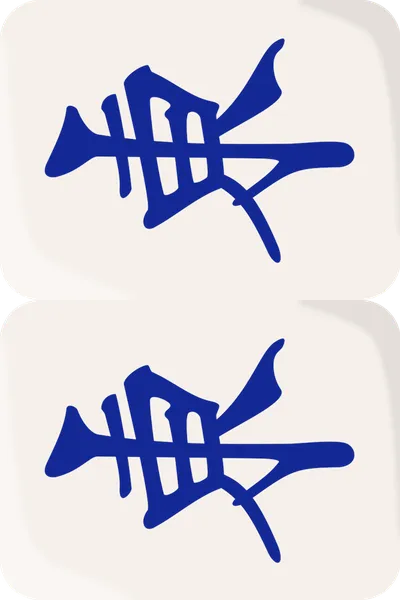
A call (also called "calling a tile") is the action of taking a tile discarded by another player and revealing part of your hand. In Riichi Mahjong, the types of calls are chii, pon, and kan, and kan is further divided into open kan and added kan. A concealed kan keeps your hand closed, so in principle it is not a call, but it is described here for convenience.
Using calls, you can take the tiles you need from other players' discards and complete your sets quickly. However, since this generally breaks a closed hand, you can no longer declare riichi and can no longer use closed-only yaku.
Calls are an important way to speed up winning, but they also have drawbacks: your hand's options narrow, and part of your hand is revealed to your opponents.
▲ Examples of the different kinds of calls. In order: chii, pon, open kan, added kan.
A call is the action of calling chii, pon, kan, or the like when another player makes a discard, and taking that discard to complete one of your own sets. The types are chii, pon, open kan, and added kan.
When you make a call, you reveal to all players the entire set completed with the tile you took, including that tile. The revealed combination is kept separate from your hand and placed face up at the right edge of the table until the round ends.
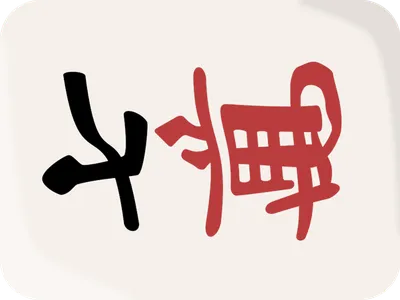
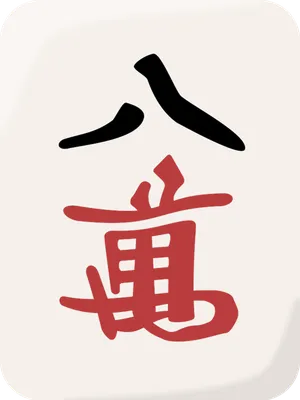
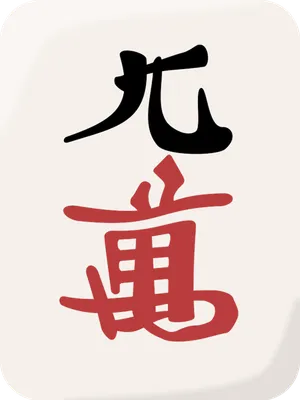
Within a revealed set, the tile you called must be placed sideways to show who you took it from and which tile you took. For example, if you chii a 7-man from the player on your left to complete a 7-8-9 man sequence, then in the revealed set the 7-man must be placed at the far left (meaning it was taken from the player on your left) and sideways (meaning the tile called from this 7-8-9 man set is the 7-man).
The purpose of a call is to quickly complete the sets you need and reach tenpai or a win. However, making a call breaks your closed hand, so you cannot declare riichi, and closed-only yaku are not established.
Chii is the action of taking a tile discarded by another player to make a sequence. You can declare chii only on a tile discarded by the player sitting directly to your left (kamicha).


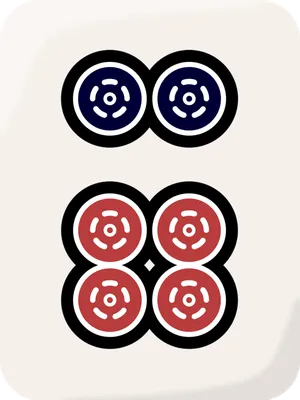
For example, if you hold 5-pin and 6-pin and the kamicha discards a 4-pin, you can take that tile to make a 4-5-6 pin sequence.
A tile taken by chii must be revealed so the other players can see it, and the two tiles from your hand used in the combination are revealed along with it.
The tile taken from the kamicha is placed sideways. Because you can chii only from the kamicha, the sideways tile is always placed at the far left, which can leave the numbers out of order, as shown below.
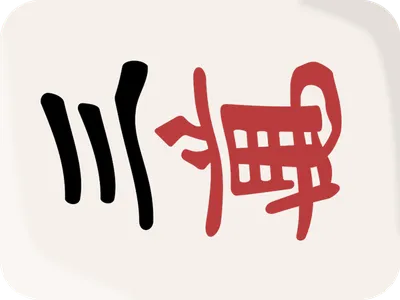
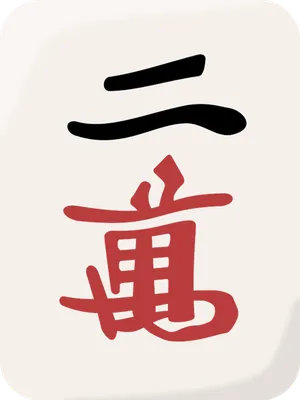
▲ When holding 2-man and 4-man and calling a 3-man discarded by the kamicha with chii.
After a chii, you have taken in one extra tile, so you must choose one tile from your hand and discard it. After that, play proceeds with the player on your right as usual.
Pon is the action of taking a tile discarded by another player to make a triplet. If you hold two identical tiles and another player discards that tile, you can declare pon.


For example, if you hold two White dragons and another player discards a White dragon, you can take it to make a triplet of three White dragons.
Unlike chii, pon can be declared on a tile discarded by any player. However, if a player has declared ron, ron takes priority.
A tile taken by pon is placed sideways. If you pon from the player on your left (kamicha), place the leftmost tile sideways; if from the player across from you (toimen), the middle tile; and if from the player on your right (shimocha), the rightmost tile. If a red five is among the tiles, you must distinguish whether the called tile is the red five or not.

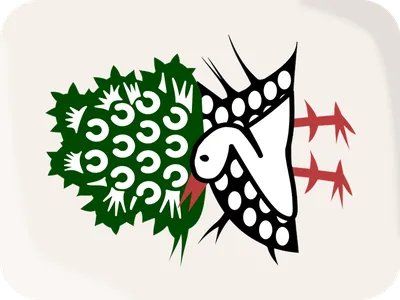
▲ When holding two 1-sou and calling a 1-sou discarded by the shimocha with pon.
After a pon as well, you have taken in one extra tile, so you must choose one tile from your hand and discard it. After that, play proceeds with the player on your right regardless of whom you called pon from.
Kan is the action of gathering four identical tiles to make a quad. Kan is divided into three types: open kan, added kan, and concealed kan. Of these, a concealed kan keeps your hand closed and so is not a call, but it is described here for convenience.
Declaring a kan means adding one tile to a set that was already complete with three tiles and using it as a four-tile set; since it is still one set, it is not regarded as having increased your tiles. Therefore, unlike an ordinary chii or pon, you draw one rinshan tile and then discard one tile.
When you draw a rinshan tile, the last tile of the wall is placed face down next to the dora indicators so that it can no longer be used. This tile cannot be used at all in this round, and it is not an additional dora indicator.
Also, when a kan is declared, a new dora indicator is revealed. For an open kan and an added kan it is revealed after you discard, and for a concealed kan it is revealed right after you draw the rinshan tile.
If the rinshan tile you draw completes your hand and you win by tsumo, a special yaku called After a Kan is established and adds 1 han.
Regardless of the type of kan, some rules include an abortive draw called Four Kans Abortive Draw when four kans have been declared in one round. If all four kans were declared by the same player, the round is not drawn. In that case, a fifth kan cannot be called.
An open kan is the action of taking a discarded tile to make a quad when you hold three identical tiles in your hand and another player discards the same tile.
An open kan is a call that takes another player's discard, so it breaks a closed hand. After declaring it, you reveal the completed four-tile quad to everyone, take a rinshan tile, and discard any tile you like from your hand.
In an open kan as well, the one tile you took must be placed sideways to show whom you took it from. If a red five is among the tiles, you must distinguish whether the called tile is the red five or not. If you took the tile from the player across from you (toimen), it does not matter whether you place the 2nd or the 3rd tile sideways.
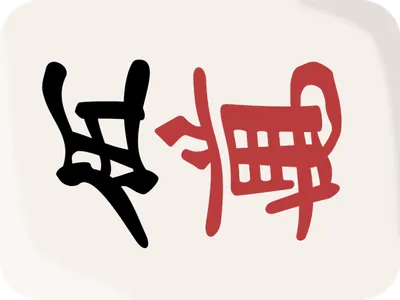
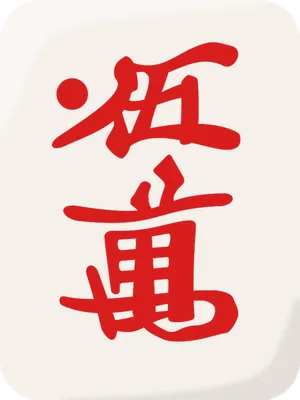
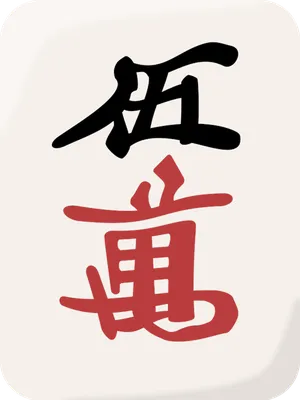
▲ When holding three 5-man and calling a 5-man (not a red five) discarded by the kamicha with kan.
You cannot declare an open kan when you already have a triplet revealed through pon and another player discards that tile. You can declare it only when you hold three identical tiles in your hand.
An open kan breaks a closed hand and also reveals an entire set that you had been keeping hidden, so in most cases it costs more than it gains. It is best done only in special situations, such as when you need to increase the number of dora, when you are aiming for yaku such as Three Kans or Four Kans, or when playing mind games.
An added kan is the action of adding a tile you drew by tsumo to a triplet already revealed through pon, when it is identical to that triplet, turning it into a quad. It is also called a shouminkan.
For example, if you previously made a pon of Green dragons and revealed a triplet of three tiles, and later draw one more Green dragon by tsumo, you can declare an added kan.
The tile used for an added kan is stacked sideways on top of the sideways tile in the triplet that was already made by pon.
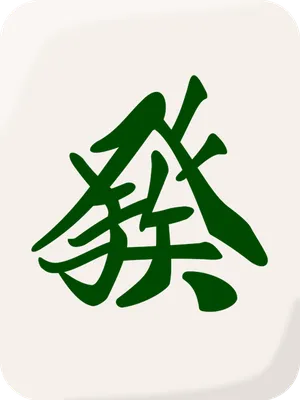
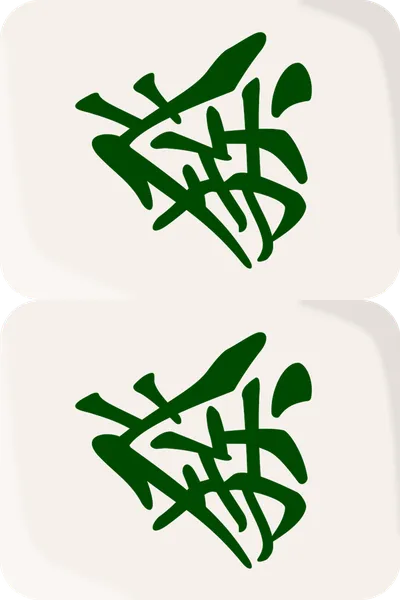
▲ When you previously ponned a Green dragon from the toimen and now draw one more Green dragon and declare an added kan.
An added kan turns a triplet you previously revealed into a quad. When you declare an added kan, there is a special rule that lets another player declare ron on the one tile used for that added kan; this is called Robbing a Kan, and it is added as a 1-han yaku.
An added kan is performed when your hand is already open from a pon, and because a new dora indicator is revealed, you may get lucky and have a dora attach to your quad, so it is preferred over an open kan. However, you should also consider using the tile as part of a sequence instead of making an added kan, and be careful about being hit by Robbing a Kan or increasing the dora of a strong opponent.
A concealed kan is a kan you declare by gathering all four identical tiles from your own hand. You do not take another player's discard, but you must reveal your tiles.
In principle, a concealed kan is not a call and keeps your hand closed. Therefore, if you have only made concealed kans, you can still declare riichi when you meet the other conditions.
When you declare a concealed kan, you place the four tiles in a revealed form, but generally you flip the two tiles at the ends face down to show that it is a concealed kan.


▲ When you declare a concealed kan with four 1-pin in your hand.
Unlike other kans, with a concealed kan the dora indicator is revealed after you draw the rinshan tile and before you discard. This gives you the advantage of being able to see what the new dora is before choosing which tile to discard.
A concealed kan keeps your hand closed, so you can declare riichi, and increasing the dora also increases the ura dora, which makes it very powerful. However, you should also consider using the tiles as part of a sequence instead of making a concealed kan, and be careful about increasing the dora of other strong opponents.
There is a special rule that allows you to win by ron through Robbing a Kan when you are in tenpai for Thirteen Orphans needing one last tile and another player declares a concealed kan on that tile. It is mainly adopted in online mahjong such as Mahjong Soul, and is not adopted in professional mahjong such as the M.League.
| Category | Chii | Pon | Open Kan | Added Kan | Concealed Kan |
|---|---|---|---|---|---|
| Combination made | Sequence | Triplet | Quad | Quad | Quad |
| Tiles needed in hand | Two consecutive tiles | Two identical tiles | Three identical tiles | A triplet already made by pon | Four identical tiles |
| Who you can take from | Kamicha only | Any opponent | Any opponent | - | - |
| Keeps a closed hand | No | No | No | Already broken | Yes |
| Rinshan replacement | None | None | Yes | Yes | Yes |
| Extra dora indicator | None | None | Yes | Yes | Yes |
A concealed kan is declared by gathering four identical tiles from your own hand, so you do not take another player's discard. An added kan extends an existing pon, so it is declared differently from an open kan.
When a player discards a tile, several players may declare a call or ron at the same time. In that case, they are resolved according to the standard declaration priority.
| Priority | Action |
|---|---|
| 1 | Ron |
| 2 | Pon or open kan |
| 3 | Chii |
Ron is another player's declaration of a win, so it takes priority over chii, pon, and kan. Pon and open kan take priority over chii, and chii can be declared only by the shimocha.
When two or more players declare ron on the same discard, how it is handled can differ depending on the rules in use, such as multiple ron or atamahane (only the ron of the one player closest to your right is honored).
Also, when pon and chii are declared at the same time, pon generally takes priority.
When you declare a call, the completed set is revealed, so the way your hand is composed changes. A standard winning hand consists of four sets and one pair, and the sets revealed by calls are included in those four sets.
For example, if you revealed one sequence by chii, you only need to complete the remaining three sets and the pair in your hand.
A kan is made of four tiles but counts as one set. Therefore, making a kan does not increase the number of sets required in a standard winning hand.
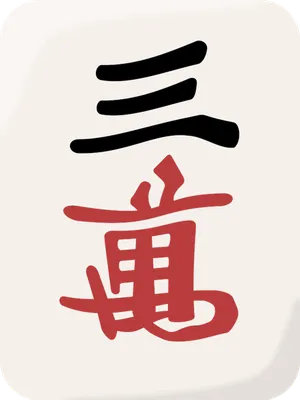


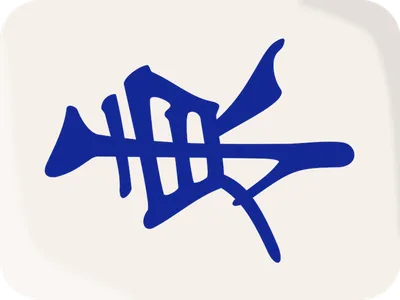

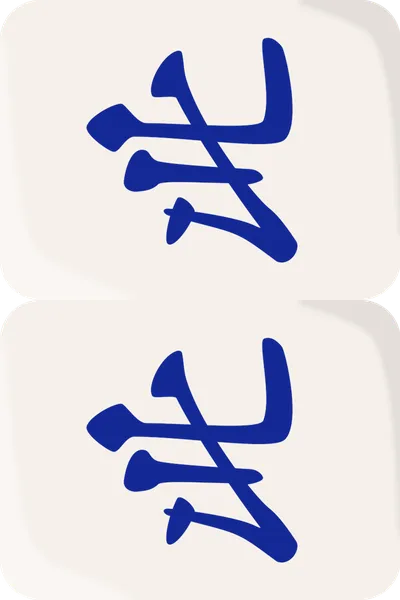
▲ Example of a winning shape with calls
Some yaku have different han depending on whether the hand is closed or open. When a call lowers the han of a yaku, this is called han reduction.
| Yaku | Closed | Open |
|---|---|---|
| Half Flush | 3 han | 2 han |
| Full Flush | 6 han | 5 han |
| Half Outside Hand | 2 han | 1 han |
| Fully Outside Hand | 3 han | 2 han |
| Mixed Triple Sequence | 2 han | 1 han |
| Pure Straight | 2 han | 1 han |
The han shown in the table are based on standard Riichi Mahjong rules. You need to distinguish yaku that are not established at all when you make a call, such as Pure Double Sequence, from yaku that merely lose han, such as Half Flush.
Kuikae is a rule that restricts immediately discarding certain tiles in connection with a tile taken by chii.
For example, suppose you hold 3-man, 4-man, and 5-man, and you chii a 2-man to make a 2-3-4 man sequence. This is a situation in which the 3-4-5 man sequence you originally had has been changed into 2-3-4 man through a chii, and the rule that restricts immediately discarding the 5-man after the chii is kuikae.
The exact scope of kuikae differs depending on the rules. Generally it is not allowed right after the chii, but you may discard the tile from your next turn onward.
Calls have the advantage of completing the sets you need quickly. In particular, ponning a Yakuhai tile or using All Simples lets you reach tenpai relatively fast.
Before making a call, you should think about which yaku you will ultimately win with. Even if you hold many dora, you cannot win without a yaku.
If you make a chii or pon, you can no longer use closed-only yaku such as Riichi, Ippatsu, and Pinfu. Before declaring a call, it is a good idea to compare it with the possibilities of keeping your hand closed.
When you make a call, part of your hand becomes known to your opponents through the revealed set. Opponents can infer your remaining winning tiles and the direction of your hand from the revealed tiles.
Making many calls shrinks your hand. If you lack safe tiles when an opponent declares riichi, defending can become difficult, so you should also consider your ability to defend before making a call.
Yes. However, you cannot win with dora alone, and you must have at least one yaku that is recognized even in an open hand.
No. A concealed kan does not take another player's discard, so it generally keeps your hand closed.
Generally pon takes priority over chii. If ron is declared, ron is resolved first.
Correct. Revealing part of your hand through a chii or pon breaks a closed hand, so in standard Riichi Mahjong you cannot declare riichi.
Under the standard rules, an additional dora indicator is revealed whenever a kan is made. However, the dora increasing and your actual hand containing a dora are two separate matters.